
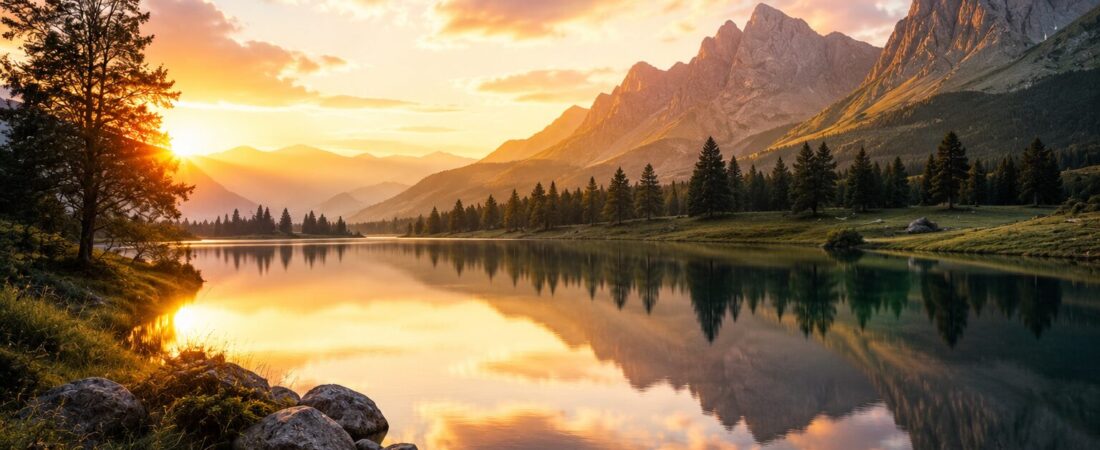
The Best Time of the Day for Landscape and Scenic Photography
Questions are always raised when people talk to me: “What is the best time for capturing nature landscapes?”
And my answer is always the same.
Don’t chase places. Chase light.
Even the most beautiful mountain, lake, beach, or forest appears to be ordinary in the glare of the sun at noon. On the contrary, even an ordinary country road looks enchanting when the light is perfect.
After many years of experience in photography, I have learned that in taking photos of landscapes, timing becomes more important than position.
The Golden Hour Deserves Its Reputation
However, if I were to select one specific period of time when I would shoot the landscape photographs, I would choose the golden hour.
This is the period of one hour right after sunrise or right before sunset.
The light is warm and soft. Long shadows create depth. Colours become richer. The landscape suddenly has character.
One may get a totally different picture of the place where one has driven through a hundred times before during golden hours.
That’s the power of light.
Sunrise Has Something Special
Even though I love watching sunsets, there is something about the sunrise that makes it different.
The world is more peaceful.
The birds are waking up for the day.
There might be mist hovering over the fields and lakes.
The air has a freshness about it that just can’t be duplicated at any other time of day.
It is a joy to watch the light slowly come over the horizon.
On some occasions, I have taken stunning pictures.
On others, not.
But either way, I never feel like I wasted my time..
Don’t Ignore the Blue Hour
Most photographers tend to get their bags and leave right when the sun sets.
I usually wait.
That short time period between sunset and sunrise is referred to as the blue hour.
During that time, the sky will be dark blue, the reflections softer, and everything will look quiet.
It is especially beneficial if you take photos of lakes, rivers, cityscapes, and the ocean.
It is better to have patience than to spend a lot of money on gear.
Midday Isn’t My Favourite
Noon time is likely the hardest period for landscape photography.
At noon, the sun hangs high up in the sky.
Shadows become harsh.
Colours lose their richness.
The sky tends to be too bright whereas the foreground will turn out to be too dark.
This does not mean that you should never shoot at noon.
Waterfalls, forest and cloudy days might give good pictures.
However, if you plan your photography trip specifically, I would advise you to skip the bright midday light.
Light Changes Everything
One lesson photography has taught me is that the landscape rarely changes.
The light does.
I’ve photographed the same place more than once.
On one visit, it looked ordinary.
On another, under different light, it looked breathtaking.
The location was the same.
The light wasn’t.
That’s the reason why many photographers visit certain locations repeatedly.
They are not searching for a new landscape.
They’re waiting for different light.
Photography Is About Patience
The practice of landscape photography makes one much more patient.
Sometimes you need to wait thirty minutes until the clouds go by.
Sometimes you have to wait for the wind to calm down.
Sometimes you just wait for the sun to appear after the rain.
And sometimes, nothing happens.
But there are lessons in each journey as well.
Photography is one field which always reminds us that we cannot rush things.
Nature does things in its own time.
My Advice
When you are learning landscape photography, the most important thing is not to have the newest cameras in the market.
Get up early.
Don’t go to sleep immediately after the sunset.
See how light changes the same place minute by minute.
Pretty soon you will realize that great landscape photos cannot be taken with an expensive equipment.
It requires a photographer to understand when to click the shutter button.

Leave a Reply