
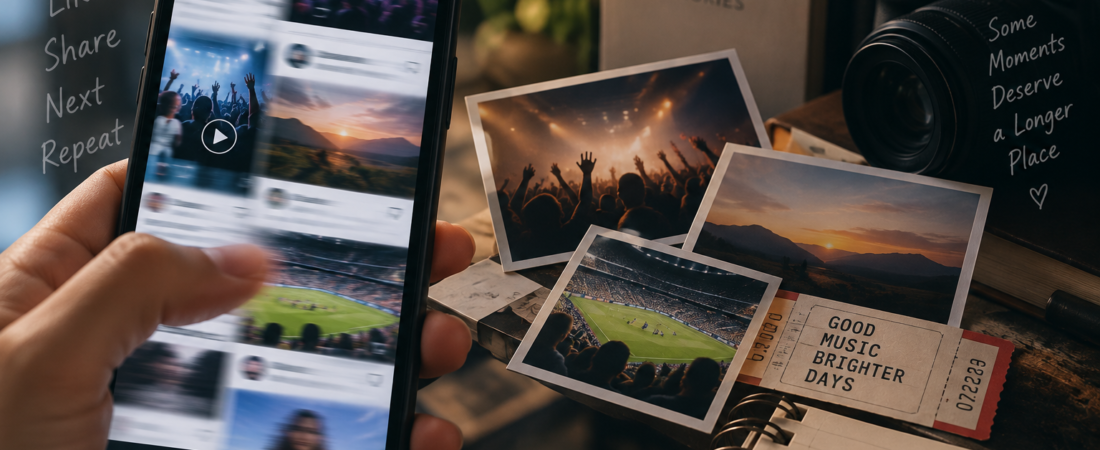
When Fandom Moves Too Fast to Remember
I sometimes wonder if we are becoming fans with shorter memories.
Not because we care less. If anything, we consume more fandom content than ever. We follow teams, actors, musicians, creators, movies and shows across multiple platforms. We watch clips, react to posts, share memes and move on to the next update.
And that may be the problem.
A social media feed never really asks us to remember. It asks us to keep scrolling.
When fandom had a memory
There was a time when a memorable moment stayed with you because there were fewer ways to consume it.
A photograph from a match could become something you saved. A movie scene could stay in your mind for years. A favorite song could remind you of a particular phase of your life. A magazine clipping, poster or ticket could become something you kept.
Fandom had physical and emotional evidence.
Today, the same moment can appear on your feed hundreds of times in different forms. A photograph becomes a reel. The reel becomes a meme. Someone analyzes it. Someone reacts to the analysis. Then another moment arrives.
The original memory gets buried.
We are seeing more, but remembering less
The speed of social media creates an interesting contradiction.
We may be exposed to more moments than previous generations, but exposure is not the same as memory.
When everything is presented as the next big thing, yesterday’s big thing quickly becomes old news.
This is particularly visible in sports and entertainment. A spectacular performance can dominate social media overnight. Fans celebrate it, argue about it and create endless content around it.
A week later, the feed has found something else.
The moment still happened. But its place in our personal memory can become surprisingly small.
Algorithms are built for what comes next
Social platforms are designed around continuous discovery.
There is always another post, another video, another controversy, another performance and another trend waiting for us.
That is useful for keeping us informed and entertained. But it is not necessarily useful for preserving memories.
A feed has no natural ending.
There is no point where it says, Stop. This was important. Remember this.
That responsibility increasingly falls on us.
Maybe this is why photographs still matter
Photography has always had a different relationship with memory.
A photograph asks you to stop.
It captures one moment instead of constantly replacing it with another. You can return to the same photograph years later and remember not only what happened, but where you were when it happened and how you felt about it.
That is very different from watching hundreds of short clips in a single sitting.
Perhaps the value of photography in the age of endless feeds is not just documentation.
It is preservation.
Fandom needs archives too
Maybe the answer isn’t to slow social media down. That is unlikely.
Instead, we may need to become better at choosing what deserves to be remembered.
Save the photograph.
Keep the ticket.
Bookmark the interview.
Write down why that particular match, concert, movie or performance mattered to you.
Create your own little archive.
Because years from now, the algorithm won’t necessarily remember what mattered to you.
You will.
And perhaps the most meaningful part of fandom is not how quickly we move from one moment to the next, but which moments we choose to carry with us.

Leave a Reply